ISO 14064 – The Framework for Reliable Carbon Footprint Measurement
The topic of climate change and decarbonisation is becoming increasingly relevant for businesses. Companies are looking for tools not only to reduce their environmental impact, but also to demonstrate it to clients, investors, and regulators. One of the most recognisable international tools is the ISO 14064 standards series.
What is ISO 14064?
ISO 14064 is a series of international standards that provide a framework for the measurement, reporting, and verification of greenhouse gas (GHG) emissions. They are used by organisations worldwide to assess their carbon footprint in a transparent and comparable way.
The standards include:
-
ISO 14064-1 – guidance for organisations on how to prepare an inventory of their emissions (direct and indirect).
-
ISO 14064-2 – guidance for evaluating specific emission reduction projects.
-
ISO 14064-3 – rules for independent verification and validation of data.
It is important to note that ISO 14064 is not a certification standard. Instead, organisations may request third-party verification of their data to ensure reliability.
ISO 14064 and ISO 14001 – how do they complement each other?
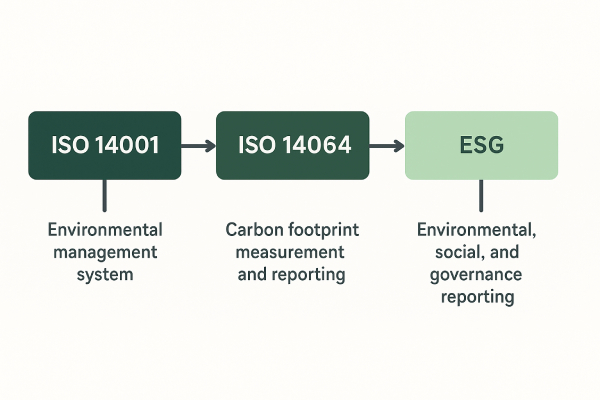
While ISO 14001 is a standard for building an Environmental Management System (EMS), ISO 14064 focuses solely on greenhouse gases. In practice, they work well together:
-
ISO 14001 provides the management framework and objectives;
-
ISO 14064 provides the methodology for calculating and reporting emissions.
For example, if an organisation with ISO 14001 sets a target to reduce its carbon footprint by 20% by 2030, it is ISO 14064 that will help measure and prove the results.
Link with ESG reporting
In recent years, ESG (Environmental, Social, Governance) reporting has become mandatory in many industries. Here ISO 14064 plays a key role:
-
it provides reliable emissions data that can be included in ESG reports;
-
it ensures trust when data is verified under ISO 14064-3;
-
it works in synergy with ISO 14067 (carbon footprint of products), enabling organisations to report not only their corporate emissions but also the impact of individual products or services.
Upcoming changes in ISO 14064
In 2024, the official revision of some of the standards began:
-
ISO 14064-1 (2018) and ISO 14064-2 (2019) – currently under revision. New versions are expected in 2026–2027.
-
ISO 14064-3 (2019) – confirmed standard, no changes planned.
-
ISO 14064-5 – a new standard, which will provide guidance for remote verification and validation. Expected publication – 2026–2027.
ISO 14064 is a valuable tool for any organisation that wants to manage and report its carbon footprint in a reliable and internationally recognised way. Combined with ISO 14001 and as part of ESG reporting, this standard provides both internal manageability and external transparency and trust.